September 26, 2026
In my first semester teaching General Ecology at COM, I’ve got a small group (just 10 students), but they are AMAZING. Super engaged, super knowledgeable, and super fun – I’m really glad to be working with this group of students this semester. Unsurprisingly, our first trip of the semester was a fantastic day in the field at Abbott’s Lagoon. During the class meeting before our trip, we all made “predictions” about how many species of birds we would see (collectively). I guessed 24, and I was WAY off. (Keep reading to see just how wrong I was).
Note: this is a summary of our day. If you’d like to see more detail about all the things we saw, I made my field journal post on my personal blog, Edge of the Map: https://www.edge-of-the-map.com/2026/09/27/abbotts-lagoon/
This was my first time visiting the lagoon, and it was SO WORTH the effort in getting there. We met at the trailhead at 12:30 p.m. (not an early start, but that didn’t seem to matter too much, in terms of the variety of things we saw). Just as we were starting down the trail to the lagoon/beach, we had some excitement: first, a Northern Harrier cruised by, and then we spotted a White-tailed Kite harassing a Red-tailed Hawk. Off to a great start.


Lots of songbirds and upland scrub – mostly Coyote Brush and Coastal Bush Lupine – on the way down to the lagoon. We passed through a marshy area that featured different vegetation, including Hedge-nettles, Great Horsetail, Pacific Aster, and Common Cowparsnip, and as we neared the lagoon, a Great Egret and Great Blue Heron were foraging along the shore.


After crossing the footbridge, we found ourselves on the sand, with the lagoon to the south and dunes to the north. Tons of birds here – Western, Heermann’s, and California Gulls, along with a large flock of Brown Pelicans. As we continued along the edge of the lagoon, there was a small group of people staring at what at first looked like an empty patch of sand dune. Then, I realized that there were birds – a good number of smallish birds running back and forth on the sand. Most of them turned out to be Snowy Plover (a threatened species that I always enjoy seeing), but there were also Least Sandpiper and Semi-palmated Plover bopping around.


Some other folks heading back from the beach let us know that they’d seen some breaching whales, so we decided to make the hike all the way to the shore. I took my time – enjoying the birds on the sand dunes and lagoon – and by the time I arrived at the shore, the whale activity had subsided, although several of my students did see plenty of spouts.
By this time, it was starting to get late enough that we’d be losing the light before too much longer (it’s about a mile and a half from bridge back to the trailhead), so we started to head back. A couple of students and I did take our time, getting thoroughly distracted by a flock of birds on the lagoon, including lots of California Gull, a Black-bellied Plover, a small flock of Long-billed Dowitcher, and a couple of Elegant Terns.

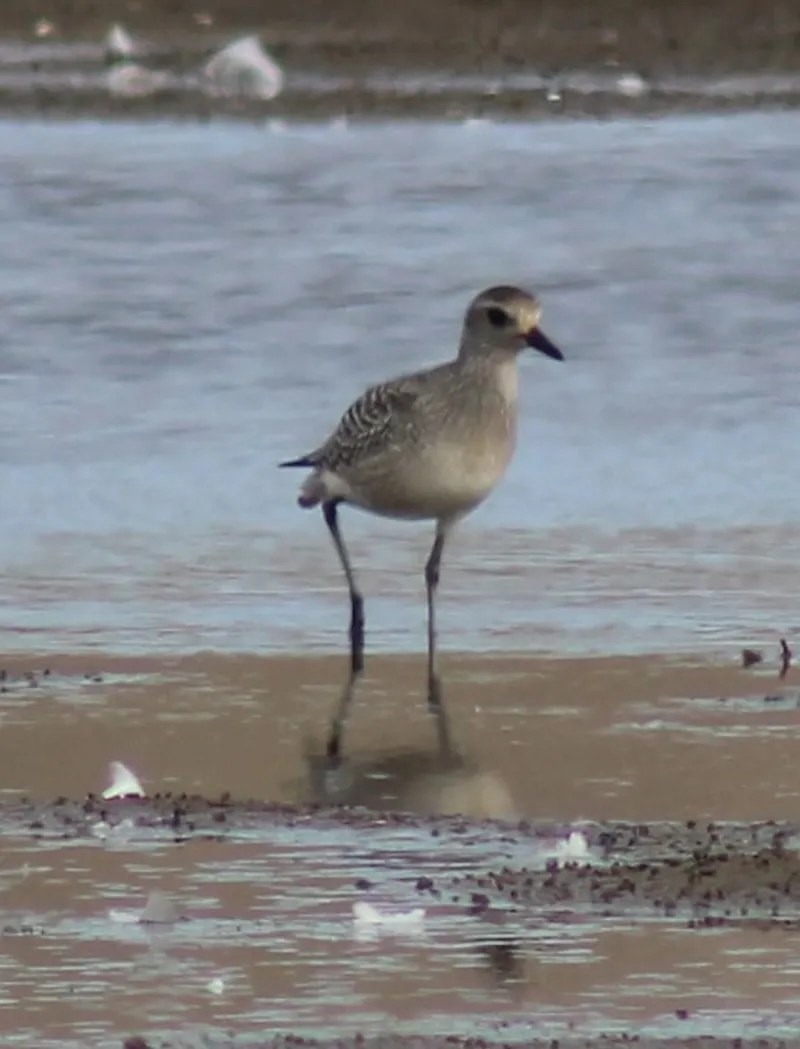

As we reached the bridge, I was hopefully that we’d see some River Otter – other folks, including many of my students – had been seeing them throughout the day. I never did manage to get a glimpse of one, but I did see their little footprints in the mud. We did see an impressive juvenile Black-crowned Night Heron at the bridge, so I wasn’t too disappointed about missing the otters. I also had a great look at a couple of Least Sandpipers.


The hike back through the upland took a while, but there were even more songbirds – mostly Song Sparrows and White-crowned Sparrows – than we’d seen on the way down. I also saw my first Columbian Black-tailed Deer of the day, and had a couple more great sightings of Northern Harrier.
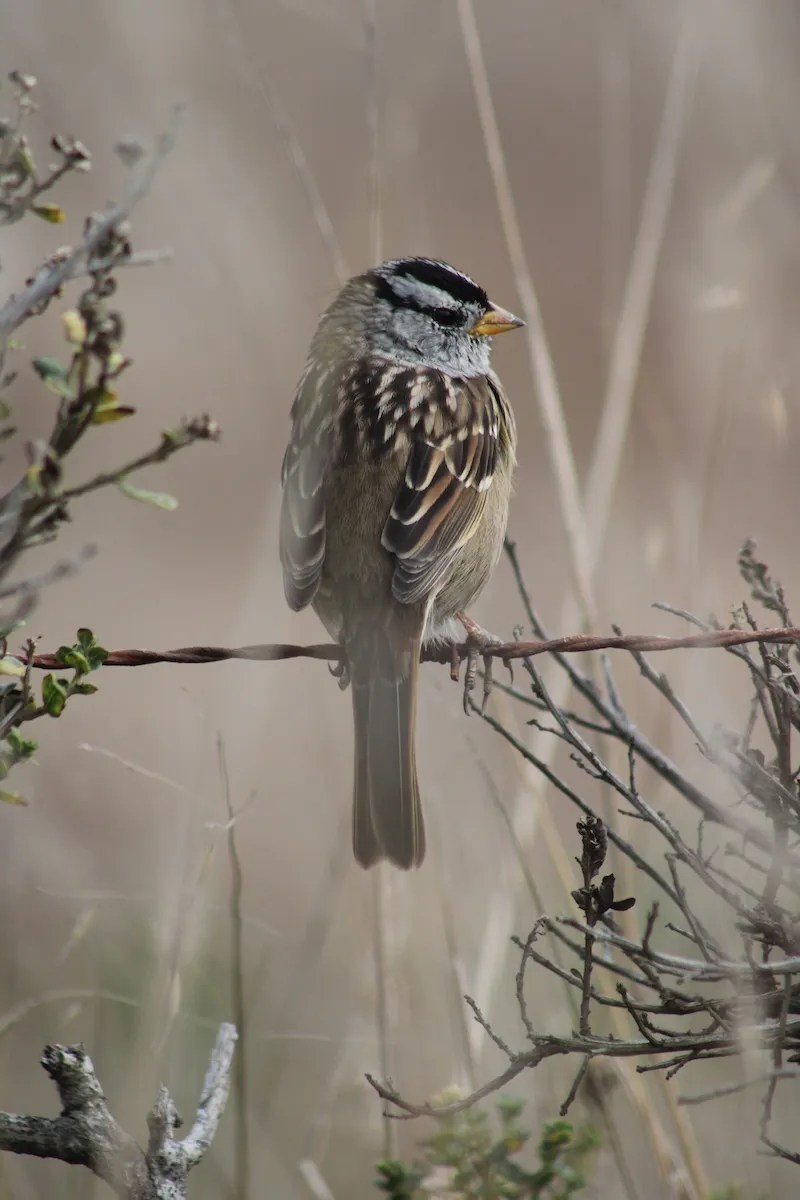


Collectively, we saw a total of 42 species of birds (a lot better than my original prediction), plus a bunch of plants and other animals. Especially as the first outing of the semester with this class, I couldn’t have had a better day.
Species List (Whole class):
| BIRDS: Common Name | Scientific name |
| American Crow | Corvus brachyrhynchos |
| Bewick’s Wren | Thryomanes bewickii — heard |
| Black-bellied Plover | Pluvialis squatarola |
| Black-crowned Night Heron | Nycticorax nycticorax |
| Black Phoebe | Sayornis nigricans |
| Brown Pelican | Pelecanus occidentalis |
| California Gull | Larus californicus |
| California Quail | Callipepla californica |
| California Scrub-Jay | Aphelocoma californica |
| Canada Goose | Branta canadensis |
| Common Merganser | Mergus merganser |
| Common Raven | Corvus corax |
| Double-crested Cormorant | Nannopterum auritum |
| Dunlin | Calidris alpina |
| Elegant Tern | Thalasseus elegans |
| Golden-crowned Sparrow | Zonotrichia atricapilla |
| Great Blue Heron | Ardea herodias |
| Great Egret | Ardea alba |
| Heermann’s Gull | Larus heermanni |
| Killdeer | Charadrius vociferus — heard |
| Least Sandpiper | Calidris minutilla |
| Mallard | Anas platyrhynchos |
| Marsh Wren | Cistothorus palustris |
| Northern Harrier | Circus hudsonius |
| Pied-billed Grebe | Podilymbus podiceps |
| Red Phalarope | Phalaropus fulicarius |
| Red-shouldered Hawk | Buteo lineatus elegans |
| Red-tailed Hawk | Buteo jamaicensis |
| Sanderling | Calidris alba |
| Say’s Phoebe | Sayornis saya |
| Semipalmated Plover | Charadrius semipalmatus |
| Short-billed Dowitcher | Limnodromus griseus |
| Short-billed Gull | Larus brachyrhynchus |
| Snowy Plover | Anarhynchus nivosus |
| Song Sparrow | Melospiza melodia |
| Turkey Vulture | Cathartes aura |
| Western Gull | Larus occidentalis |
| White-crowned Sparrow | Zonotrichia leucophrys |
| White-tailed Kite | Elanus leucurus |
| Willet | Tringa semipalmata |
| Yellow-rumped Warbler | Setophaga coronata |
| Wrentit | Chamaea fasciata — heard |
| PLANTS: Common name | Scientific name |
| Beach Strawberry | Fragaria chiloensis |
| California Blackberry | Rubus ursinus |
| California Coffeeberry | Frangula californica |
| California Mugwort | Artemisia douglasiana |
| California Poppy | Eschscholzia californica; coastal form listed as E. californica maritima |
| Coastal Bush Lupine | Lupinus arboreus |
| Coastal Gumplant / Oregon Gumplant | Grindelia stricta |
| Coastal Hedge-Nettle | Stachys chamissonis |
| Coastal Sagewort | Artemisia pycnocephala |
| Common Cowparsnip | Heracleum maximum |
| Common Mustard | Brassica rapa |
| Common Velvetgrass | Holcus lanatus |
| Common Yarrow | Achillea millefolium |
| Cobwebby Thistle | Cirsium occidentale |
| Coyote Brush | Baccharis pilularis; includes prostrate form |
| Curly Dock | Rumex crispus |
| Fennel | Foeniculum vulgare |
| Giant Vetch | Vicia gigantea |
| Great Horsetail | Equisetum telmateia |
| Hairy Brackenfern / Western Bracken Fern | Pteridium aquilinum pubescens; other list gave P. aquilinum sp. |
| Harding Grass | Phalaris aquatica |
| Marsh Jaumea | Jaumea carnosa |
| Pacific Aster | Symphyotrichum chilense |
| Pearly Everlasting | Anaphalis margaritacea |
| Poison Hemlock | Conium maculatum |
| Poison Oak | Toxicodendron diversilobum |
| Rattlesnake Grass | Briza maxima |
| Red Willow | Salix laevigata |
| Rush | Juncus patens; another list gave Juncus sp. |
| Scarlet Pimpernel | Lysimachia arvensis |
| Seaside Daisy | Erigeron glaucus |
| Sheep Sorrel | Rumex acetosella |
| Silver Beachweed | Ambrosia chamissonis |
| Slim Oat | Avena barbata |
| Yellow Sand Verbena | Abronia latifolia |
| OTHER WILDLIFE: Common name | Scientific name |
| Cardinal Meadowhawk | Sympetrum illotum — orange/red dragonfly |
| Cabbage Butterfly | Pieris rapae |
| Monarch Butterfly | Danaus plexippus |
| Sandhill Skipper | Polites sabuleti |
| Common Thread-waisted Wasp | Ammophila procera |
| North American River Otter | Lontra canadensis |
| Columbian Black-tailed Deer | Odocoileus hemionus columbianus |
| Coastal Coyote | Canis latrans clepticus |
| Feather Boa Kelp | Egregia menziesii |


0 Comments